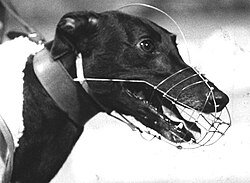
The supreme showman
A greyhound who turned every race into theatre
Scurlogue Champ became famous for conceding enormous early leads before producing a powerful, weaving finish that regularly brought packed grandstands to their feet.
Scurlogue Champ was born in County Wexford in 1982 and bred by Francis Kent. His name came from the farm at Scurlogue where he spent part of his early life. Nothing about those beginnings suggested that he would become one of the most recognisable racing greyhounds of the 1980s. In fact, he was once exchanged for a cow when the needs of a dairy herd became more pressing.
After showing promise in Ireland, he was offered at the Shelbourne Park sales in Dublin. British trainer Ken Peckham had travelled across to see him and was impressed by the way he won his sales trial. Although Brendan Matthews secured him at auction for 1,500 guineas, Peckham later arranged a private deal and brought the black greyhound to England.
Scurlogue Champ made his British racing debut at White City in 1984. From the outset, spectators saw that he was no ordinary stayer. He often began slowly and could trail the field by a seemingly hopeless margin, yet his stamina and finishing speed allowed him to gather momentum as the race developed. By the closing bends, the distant leaders would suddenly come within reach.
His style made him an extraordinary attraction. Crowds did not simply attend to see whether he would win; they came to watch how he might escape from another impossible-looking position. As he started his charge, racegoers would often take up a chant of his name, creating an atmosphere more commonly associated with a football ground than a greyhound stadium.
Between 1984 and 1986, Scurlogue Champ won 51 of his 63 races in Britain and started favourite on 60 occasions. He established track records over a remarkable range of long distances, from 663 metres at Hall Green to 888 metres at Catford. These figures demonstrate that the excitement surrounding him was supported by exceptional and sustained ability.
Among his best-known achievements were two victories in the BBC Television Trophy, which introduced his spectacular racing style to an audience far beyond the regular track-going public. He also won the Cesarewitch and built an unbeaten sequence of 16 races during the height of his career.
Scurlogue Champ's performances were particularly striking because they appeared to defy the normal pattern of racing. A greyhound giving away ten or even twenty lengths would usually be considered beaten, but he could still produce enough speed and stamina to sweep past rivals late in the contest. His ability to repeatedly recover from such positions earned him a reputation as one of the finest distance runners the sport had seen.
His racing career ended in 1986 after a wrist injury, but his place in greyhound history was already secure. Alongside champions such as Ballyregan Bob, he helped renew public interest in the sport during the middle of the decade. Scurlogue Champ is remembered not only for victories and records, but for the sense of anticipation he created whenever he stepped onto a track.
Many champions dominate races from the front. Scurlogue Champ became a legend by doing almost the opposite. He allowed the drama to build, appeared to leave himself too much to do and then delivered the kind of finish that spectators never forgot.