| The Rules of Backgammon | |
How Many Players?Backgammon
is a game for 2 players with 15
checkers (pieces) per player and two
dice. A doubling cube bearing the
numbers 2,4,6,16,32 and 64 is used
to keep track of the stakes. |
|
The BoardThe
board consists of 24 narrow
triangles called "points",
which are alternate in colour and
grouped into 4 quadrants of 6
triangles each. The
quadrants are named the player's
home board and outer board, and the
opponent's home board and outer
board. The home and outer boards are
seperated from each other by a line
down the middle called the
"bar". These
points are numbered for each player,
starting in the players home board.
The outermost point is the 24 point
for one player, and also the
opponents one point and so on. |
|
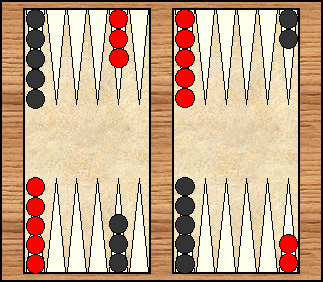
Starting PositionsThe
starting positions of the checkers
on the board are the same every time
you play backgammon. The board shown
right shows exactly how the checkers
should be laid out. |
 |
| Object
of the Game
The object of the game is for a player to move all of their checkers into their own home board and then remove from the board. The first player to remove all their checkers wins. How you move |
|
Each player throws a single die and
the player with the higher number goes
first. That player then throws both
dice and moves according to the number
on the dice. The checkers always move
forward and can only move to a certain
point if one of the following
conditions are met:
The number on the dice count for different moves. For example if a player throws a 5 and a 2 they can move one checker 5 and another 2, or they could choose to ad the scores together and move one checker 7. When only one move is possible the player must make that move. If either number can be played but not both then the higher number has to be played. Of the player rolls identical numbers (called a doublet) he can move up to 4 checkers. Stakes Backgammon is played for an agreed stake per point. Each game starts at one point and, during the game a player with an advantage may wish to offer to double the stakes. He can only do this at the start of his turn before rolling the dice.A player who is offered a double may refuse and concede the game paying one point. If they accept they play on for higher stakes. Only a player accepting a double can call the next double. The process is called "doubling". Subsequent doubles are called redoubles. If a player refuses a redouble they pay the number of points at stake before the redouble. The doubling cube is used to keep track of the stakes. Hitting and Entering A point occupied by a single checker is called a blot. If an opposing checker lands on a blot, the blot is "hit" and the checker is placed on the bar. Whenever a player has a checker on the bar, this has to be removed into the opposing players home board, if they cannot do this then they miss a go. Bearing Off Once a player has moved their 15 checkers into their home board, they begin bearing off. A player bears off by rolling a number which corresponds to the point where one of their checkers is lying. e.g rolling a four means the player can remove a checker from the four point.A player must have all their checkers in their home board to bear off. If a checker is hit while a player is bearing off, they must bring that checker back to their home board before they continue bearing off. The first player to bear off all 15 checkers wins the game. Gammons and BackgammonsIf a losing player has borne off at least one checker they lose the value shown on the doubling cube. If the loser hasn’t borne off any of their checkers, they’re "gammoned" and lose twice the value of the doubling cube. If the loser hasn’t borne off any of their checkers and still has a checker on the bar or in the winners home board, they’re "backgammoned" and lose three times the value of the doubling cube. |
|